Full plastic (PVC/PP) boards are often marketed as the modern, weatherproof alternative to timber. On paper, that sounds ideal for wind-and moisture-heavy environments.
On site, the reality is different. Plastic boards struggle with the exact conditions high-end construction demands:
- Poor fastener grip. Smooth plastic doesn’t bite around nails, and screws strip out of the threading under lateral pressure. This is precisely the kind of load wind-driven bracing puts on a formwork joint.
- Creep and sagging. Under sustained structural load or heat, plastic deforms, forcing tighter shoring spacing just to hold a flat line, a costly workaround on sites where speed and stability both matter.
- Impact vulnerability. Dropped rebar or scaffold joints can crack brittle plastic outright or punch through hollow cores. Common on active, wind-buffeted high-rise floors.
None of these is theoretical. They are the failure points that show up as bowed concrete lines, reworked panels, and delayed pours.
Formwork Material Analysis: Full Plastic vs. Green PP Semi-Plastic Boards
| PERFORMANCE FEATURE | FULL PLASTIC BOARDS (SOLID/HOLLOW PVC) | GREEN PP SEMI-PLASTIC BOARDS (METRIC WOODS) |
|---|---|---|
| Structural Strength | Flexible & Prone to Sagging: Experiences material “creep” under high structural concrete load or hot hydration temperatures, requiring dense shoring spacing to prevent deflection. |
Highly Rigid & Deflection-Free: Multi-layered cross-laminated hardwood core provides natural load-bearing stiffness. Guarantees perfectly flat concrete lines under normal support spacing. |
| Fastener & Nail Retention | Low Mechanical Grip: Plastic does not compress around smooth nails, leading to loose structural bracing. Screws can easily strip out the plastic threading under high lateral pressures. |
Superior Fastener Bite: High-density engineered wood core grips screws and common nails tightly, securing joints firmly and preventing formwork shifting during heavy pouring. |
| On-Site Workability | High Machine Friction: Cutting with hand or table saws creates localised melting that gums up carbide teeth, accelerating tool wear and producing toxic fumes. |
Standard Carpentry Hand: Handles seamlessly using standard carpentry tools. Cuts cleanly without fraying, delaminating, or changing blade lifecycle metrics. |
| Weight & Ergonomics | Ergonomically Challenging: Solid versions are up to 40% heavier than plywood, increasing labour fatigue. Hollow versions are lighter but structurally compromised. |
Optimal Weight Balance: Retains the manageable, high-strength-to-weight profile of calibrated plywood, allowing swift multi-tier manually hoisted deployment. |
| Impact Resistance | Susceptible to Punctures: Heavy dropped iron rebars or scaffolding joints routinely crack brittle frozen solid plastic or pierce straight through hollow cavities. |
Impact Deflecting Core: The structural plywood core acts as an impact buffer. Tough 0.5mm outer shell may take cosmetic scratches but prevents catastrophic structural ruptures. |
| Concrete Surface Quality | Smooth but Irregular: Delivers a glossy concrete texture, but often suffers from overall surface wave-lines due to localised bowing between structural supports. |
Mirror-Smooth & True: Gives an impeccably uniform, flat, mirror-like structural concrete surface that eliminates standard plastering and rendering costs completely. |
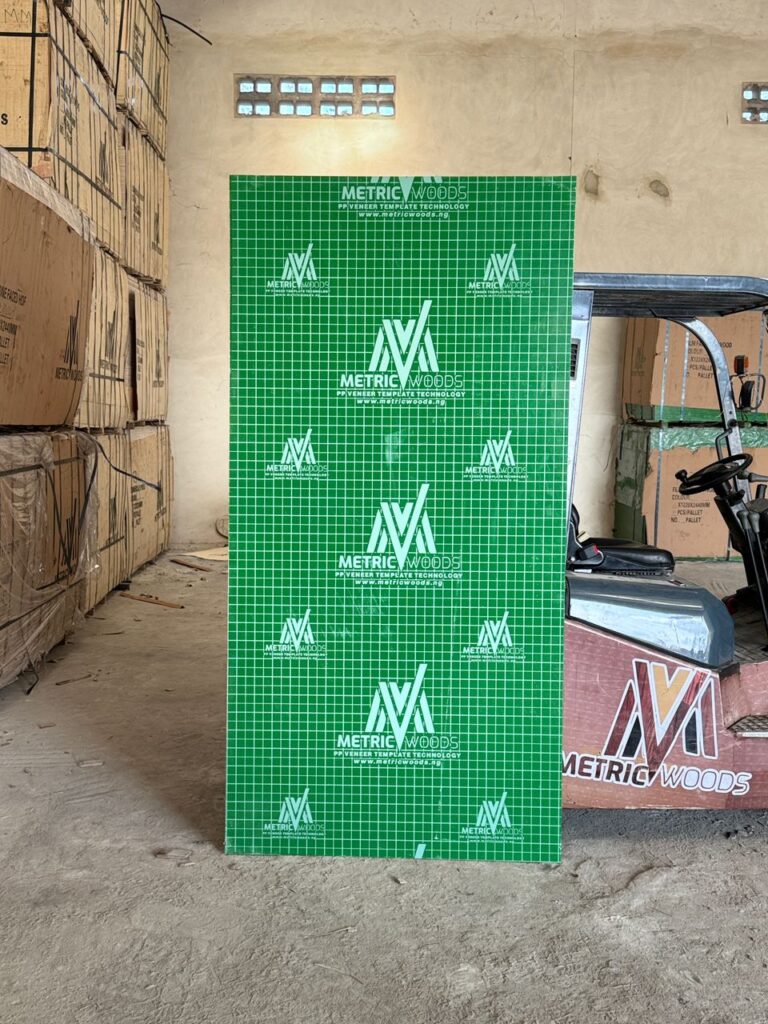
The table above provides a structural and functional comparative analysis between Full Plastic Formwork Boards (solid or hollow-core PVC/PP) and Green PP Semi-Plastic Marine Boards (engineered hardwood core with a 0.5mm Polypropylene composite skin). This evaluation reflects real-world site performance, structural reliability, and operational ergonomics for engineering projects.
Where Green PP Semi-Plastic Boards Hold Their Ground
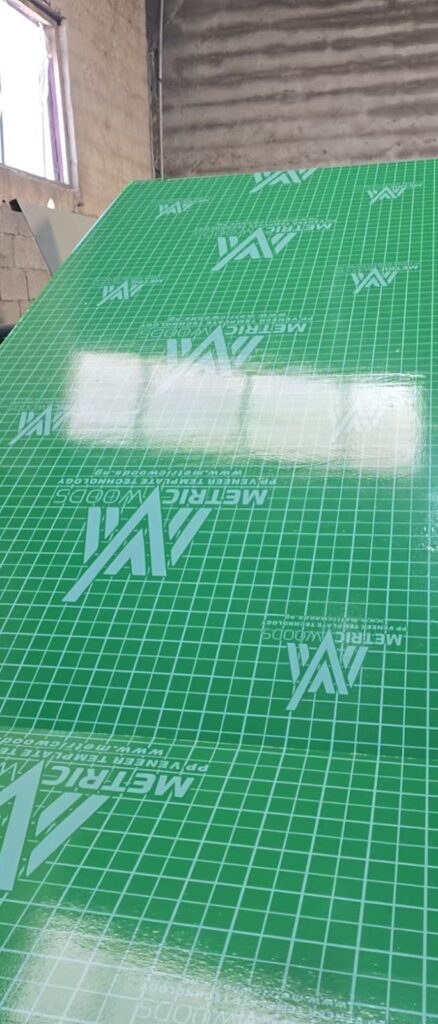
Metric Woods’ Green PP Semi-Plastic Marine Boards are engineered differently: a cross-laminated hardwood core wrapped in a 0.5mm polypropylene composite skin. This hybrid composition is exactly what high-end sites need.
- Bracing actually stays braced.
Its high-density engineered wood core grips nails and screws with real mechanical bite. On a windy site, where bracing takes continuous lateral stress, the difference between formwork that holds and formwork that shifts mid-pour is crystal clear.
- Rigidity without the shoring workarounds.
The multi-layered core resists deflection under normal support spacing; no need to over-engineer shoring just to compensate for a flexing board. That means fewer adjustments when wind and load are already working against your timeline.
- A structural buffer, not a brittle shell.
Where full plastic cracks or punctures on impact, the plywood core inside a Green PP board absorbs it. The polypropylene skin may pick up a cosmetic scratch, but the structural integrity underneath stays intact. On an active, wind-exposed site, that resilience matters more than a glossy finish.
- Weight works with your crew, not against them.
Green PP boards retain the manageable strength-to-weight profile of premium plywood—lighter and easier to hoist across multiple tiers than solid plastic, without the structural compromise of hollow-core alternatives.
- A concrete finish that holds its line.
The payoff: a mirror-smooth, structurally true concrete surface, not the wave-lines and localised bowing that come from boards flexing between supports.
The Bottom Line
High-end construction punishes weak points in bracing, fastening and material rigidity.
While full plastic options seem advantageous on paper regarding moisture exposure, the physical realities of the construction site demand structural rigidity and predictable mechanical workability. Green PP Semi-Plastic Boards deliver the ideal compromise: providing the waterproof durability and high repetition cycles of a polymer surface, while retaining the premium stiffness, weight, and predictable fastening metrics of premium wood.
Metric Woods Green PP Semi-Plastic Marine Boards were built to answer exactly those pressure points: engineered wood strength, polymer-grade durability, and fastener security that holds under lateral stress.
It’s the same principle behind everything we supply at Metric Woods; from 18mm marine board to HDF and commercial plywood. These materials are chosen for how they perform on site, not just how they read on a spec sheet.
Metric Woods — Direct importers and suppliers of Marine Boards, HDF, and Commercial Plywood, Ajah, Lagos.